The Tesla flying car is real.
It just does not fly the way you think.
On 15 October 2026 a Tesla Roadster drove up a ramp, left the ground on SpaceX-developed thrusters and landed on its wheels. That is a genuine engineering result. It is also a few seconds of controlled hop, not a commute. Here is what was proven, what was not, and what would make it useful.
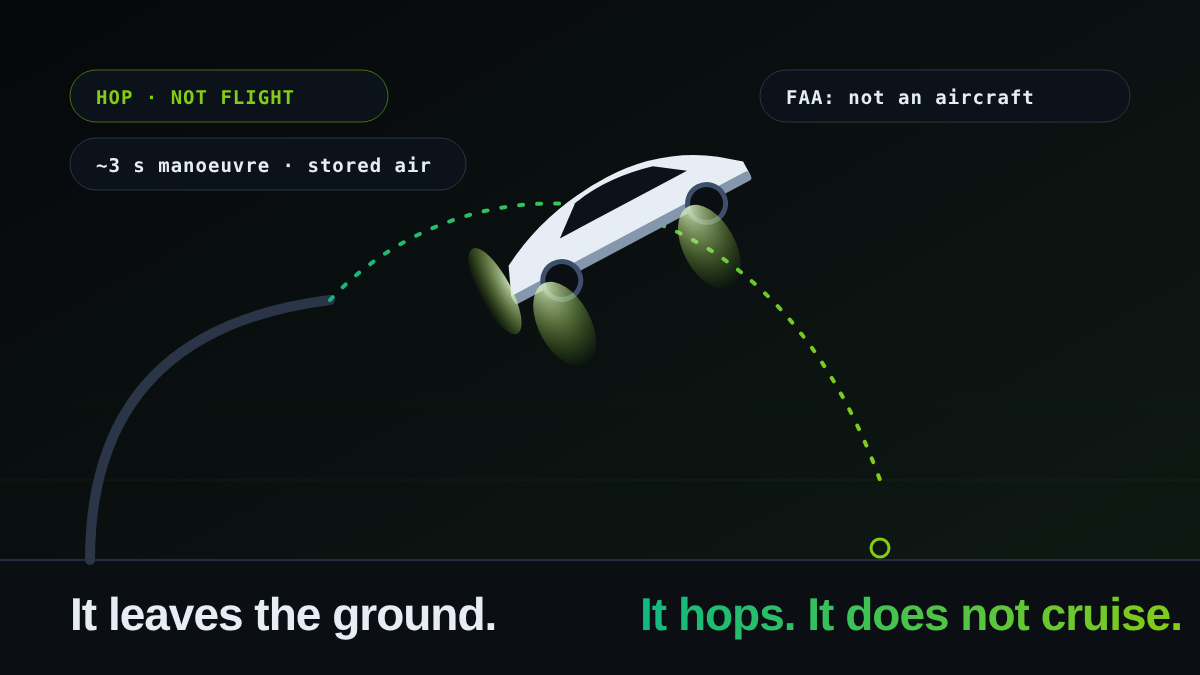
Does the Tesla flying Roadster actually fly? Yes, for a few seconds. It uses SpaceX-developed compressed-air thrusters to hop, flip and land, not wings or rotors to stay in the air. It is a working prototype of a car due in 2028, not a vehicle that can carry you over traffic.
// Chapter 01 — What actually happenedA car left the ground. On purpose. And landed on its wheels.
On Thursday 15 October 2026, at SpaceX's test site in McGregor, Texas, Tesla showed a redesigned Roadster to a livestream audience. A white prototype drove up a curved ramp and carried on upside down, held to the surface by suction fans. It left the ramp, rotated in mid-air using bursts of compressed air, and landed on its wheels. In a second routine it fired thrusters to hop over a row of parked Tesla vehicles. Elon Musk's verdict on X: "Turns out the future does have flying cars."
One detail matters more than the stunt itself. Nobody was driving. Reports describe a pre-programmed sequence, with a mannequin in a SpaceX spacesuit in the seat, and Musk said the car ran autonomously for safety reasons.
// Chapter 02 — Credit where it is dueThis is real engineering, and it deserves a straight hearing
It is easy to wave this away because of Tesla's record on dates. Do not. The physics on display is genuine. The car carries roughly 600 litres of rechargeable compressed air (about 250 kg, according to event statements relayed by a Tesla fan site) in two pressure vessels. Thrusters on the underside and rear lift it and cushion landings, with smaller side thrusters rotating it in the air. Underbody fans pull it down onto a surface hard enough that Tesla claims cornering above 2 G. Tesla claims 0 to 60 mph in 0.81 seconds. Every one of those figures still needs independent testing, but nothing in the demo contradicts physics.
Some observers asked whether the stunt car was a complete, working vehicle, and one commentator wondered aloud if the event was a prank. A fair reading is that the manoeuvres were real and the prototype was a stunt-grade machine, which is a very different thing from a product.
It flies, but not the way an aeroplane flies
Most people hear "flying car" and picture something that stays up. The Roadster does not work like that. It stores a fixed amount of air and spends it.
What the demo proved, and what nobody has published
- Drove upside down on a ramp using suction fans
- Launched, rotated in mid-air and landed on its wheels
- Hopped over parked vehicles on thruster power
- Controlled attitude with side thrusters
- Ran without a driver on a scripted sequence
- How long it can stay airborne
- Maximum height or distance in the air
- How it performs with a person aboard
- How long refilling and recompressing takes
- Occupant safety systems for a flight
- Independent verification of the headline figures
The history adds context. The second-generation Roadster was unveiled in 2017 with four seats, a claimed 620-mile range and a 1.9 second 0 to 60 time, for a 2020 launch. Today it is a two-seater with a range of "more than 300 miles", with production now planned for 2028.
// Chapter 05 — The straight answerIs it practical and useful yet?
For getting anywhere, no. Tesla's own website says the Rocket version is not approved for public road use. The FAA told CBS News and Politico the vehicle does not meet its definition of an aircraft, which means it would not need airworthiness certification, and it is unclear which regulator would oversee the flying part. Musk has said, "This is not necessarily a safety-optimized car," and that he is not sure it will be legal in all jurisdictions.
The business case is a halo car, not a commuter. Analyst Dan Ives wrote that it "will not move the volume or revenue needle," and Musk said in 2023 it was "definitely not gonna be a huge contributor to revenue." Reservations start at $50,000 for the Performance version ($5,000 up front and $45,000 within 10 days), the Thrust version has been reported at $250,000, and the single-seat Rocket is invitation-only. Final prices are not announced. The reservation terms say it does not guarantee delivery, and the money is not held in escrow.
// Chapter 06 — Make it usefulWhat would turn a great stunt into something useful
We like the idea, and that is the point of asking hard questions. A flying vehicle becomes useful when it passes three tests. Today the Roadster passes none of them for transport.
Here are three ways we think the idea could become useful. These are our views, not Tesla's plans.
- Sell the stunt first. Film, motorsport and show events are places where three seconds of controlled thrust is the whole product, and the demo itself is the proof.
- Make the hop the product. A controlled hop of a few metres with a soft landing could clear an obstacle gap for rescue or off-road vehicles. That is a narrower and more realistic goal than commuting, but it needs a regulator willing to classify it.
- Separate the layers. If the goal is transport, the proven routes are fan or wing designs. Alef's Model A, according to New Atlas, received a limited FAA special airworthiness certificate for prototype flight in 2023, drives at about 25 mph and flies roughly 110 miles. Air taxis are still working through certification, and as of late 2025 some analysts did not expect Archer's final type certification until 2028. Keep thrusters for performance, and let real flight be designed as flight.
The questions worth asking about any bold demo
At Forge Vertical we apply the same filter to a Cape Town flyer and a Texas launch event. A demo shows that something can happen once. A product shows it happens every time, for a paying person, inside the rules. Ask five questions: how long, how far, with whom aboard, who certifies it, and who services it? The Roadster has an answer to the first only in seconds and has not published the rest. Ask the same of any vendor pitching you AI, software or infrastructure.
Does the Tesla flying Roadster actually fly?
It leaves the ground for a few seconds. In the 15 October 2026 demo the prototype used SpaceX-developed compressed-air thrusters to launch off a ramp, rotate in mid-air and land on its wheels, and to hop over parked cars. That is a controlled hop, not sustained flight like an aeroplane or helicopter, and Tesla has not published how long or how far it can stay airborne.
How does the Tesla flying car work?
It releases stored compressed air through thruster nozzles to push the car up and rotate it in the air, and uses underbody suction fans to hold it to a surface. Tesla's engineering VP Lars Moravy said the car carries about 600 litres of rechargeable compressed air. The thrusters were developed with SpaceX, and Tesla says the air tanks are recharged without fuel.
How long can the Tesla Roadster stay in the air?
Tesla has not published a flight time, altitude or range. The demonstrated manoeuvres lasted a few seconds each, and a back-of-envelope estimate from the reported air supply and thrust suggests the stored air can sustain only seconds of thrust.
When can you buy the Tesla flying Roadster and how much does it cost?
Tesla says production is planned for 2028. Reservations are open: the Performance version needs a $50,000 reservation ($5,000 up front and $45,000 within 10 days), and the Thrust version was reported at $250,000. The single-seat Rocket version with the flight system is invitation-only. Final prices have not been announced, and a reservation does not guarantee delivery.
Is the Tesla flying Roadster legal to fly or drive?
Tesla's website says the Rocket version is not approved for public road use. The FAA told CBS News and Politico that the vehicle does not meet its definition of an aircraft, so it would not need airworthiness certification, and it is unclear which regulator would oversee the flying features. Elon Musk said he is not sure it will be legal in all jurisdictions.
Is the Tesla flying car practical or useful yet?
Not yet. Today it is a halo car and an engineering demonstration: a few seconds of controlled thrust, two seats, no published airborne range and no regulator for the flying part. It becomes useful when it can stay aloft long enough to cross a real obstacle safely, fits a legal vehicle category and protects the people aboard.
- Fortune: Tesla is taking $250,000 deposits for a Roadster with SpaceX thrusters. The FAA says it isn't an aircraft
- TechRepublic: Tesla flying car demo reveals three Roadster versions
- Dezeen: Tesla launches flying Roadster concept car
- Yahoo Autos: Tesla demonstrated a flying Roadster. Don't expect it on the road anytime soon
- Tesla Oracle (fan site, not affiliated with Tesla): how the flying Roadster stunts work
- New Atlas: Alef eVTOL airworthiness certificate
- Nasdaq / Motley Fool: Archer Aviation FAA certification progress (Nov 2025)