ai-catalog.json:
the robots.txt for AI agents?
A new file, backed by Google, Microsoft, GitHub, Nvidia and others, tells AI agents what your domain offers. What it is, how it differs from llms.txt and schema, what is proven so far, and whether a small business should bother.
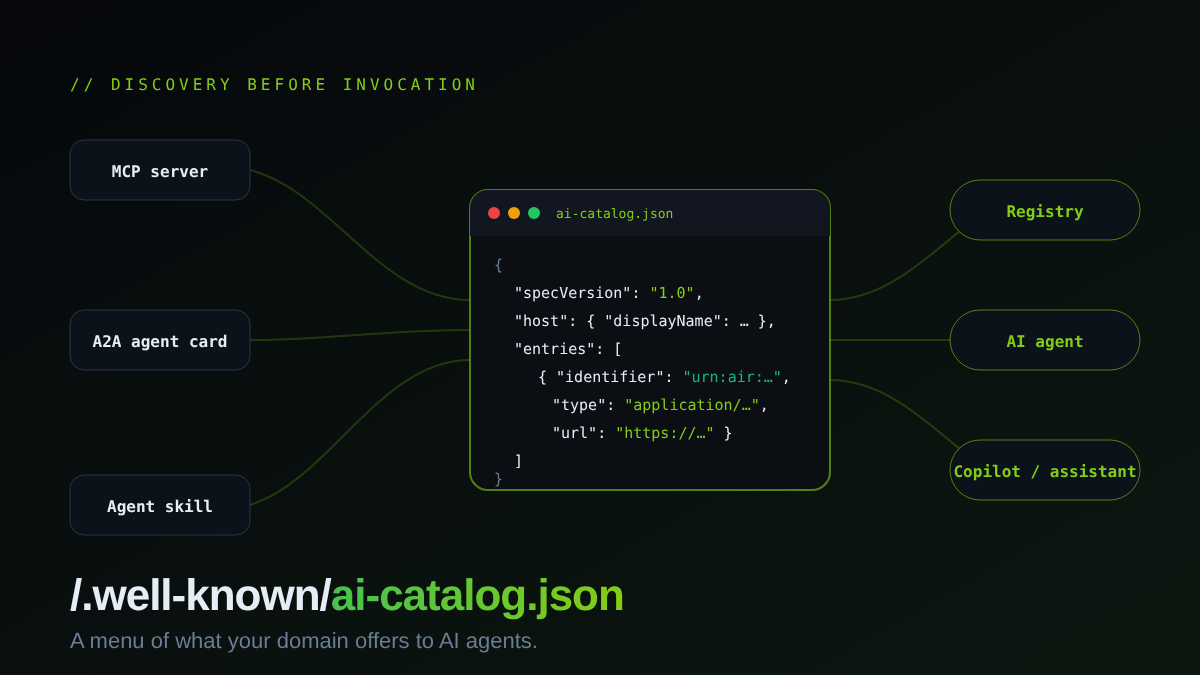
What is ai-catalog.json? It is a machine-readable file a website or company publishes at /.well-known/ai-catalog.json to list the AI-usable resources it offers, such as MCP servers, A2A agent cards and agent skills. AI agents and registries read it to discover what exists before they try to call anything.
Agents can call tools. Finding them is the hard part.
Protocols like MCP define how an AI agent invokes a tool once it knows the tool exists. They say nothing about how the agent finds that tool in the first place. Today that happens through hardcoded integrations, hand-edited config files and marketplaces. ai-catalog.json is the "before" step: discovery before invocation. The idea is the same as robots.txt and sitemap.xml for crawlers: a predictable URL on your own domain where a machine can ask, "what do you offer?"
// Chapter 02 — Who is behind itA coalition of big names, and a draft that is still moving
The file is the publishing side of Agentic Resource Discovery (ARD), a draft standard. According to AI Weekly, eleven companies published it on 17 June 2026: Google and Microsoft with Salesforce, Snowflake, ServiceNow, Cisco, Databricks, GitHub, GoDaddy, Hugging Face and Nvidia. It is Apache 2.0 licensed and builds on an AI Catalog data model maintained by a Linux Foundation working group. The same report says Anthropic and OpenAI are not among the backers. InfoQ reported it on 14 July, and another guide dates Google's announcement to May. The sources disagree on the exact date, which tells you how new this is.
Small, plain JSON
Per the specification, a catalog needs only a specVersion and an entries array. A host block with a display name is optional. Each entry needs an identifier, a type (a media type string), and exactly one of url or inline data. Descriptions, tags, versions and a signed trust manifest are optional, and consumers must ignore fields they do not recognise.
// /.well-known/ai-catalog.json (example from the spec site)
{
  "specVersion": "1.0",
  "host": { "displayName": "Example Hub" },
  "entries": [
    {
      "identifier": "urn:air:example.org:mcp:weather",
      "type": "application/mcp-server-card+json",
      "url": "https://example.org/mcp/weather/server-card"
    }
  ]
}
Identifiers follow the pattern urn:air:{publisher}:{namespace}:{name}, where the publisher is your domain. Recommended types include MCP server cards, A2A agent cards, agent skills and nested catalogs.
Five files, five jobs
If you already work on SEO, AEO and GEO, this is the new layer on top of what you have. It does a different job from each of the others.
Interesting is not the same as proven
- A published draft with large backers
- Registries are meant to crawl catalogs and answer agents' plain-language queries
- It sits above MCP and does not replace it
- GitHub and Hugging Face are reported as early implementers
- It is free and just a static file
- Whether major assistants will fetch small-site catalogs
- Whether Anthropic or OpenAI will join or build their own
- Whether it affects AI citations at all
- How registries will rank who gets discovered
- Whether the draft will change before it settles
One more caution from the people building it: Microsoft's Jennifer Marsman said ARD "doesn't replace authentication, authorization, governance, or organizational trust decisions." Discovery tells an agent a tool exists. It does not decide whether the agent should be allowed to use it. And as API Evangelist notes, roughly three-quarters of providers still do not publish comparable discovery files such as APIs.json or Agent Cards.
// Chapter 06 — Should you publish one?Our answer: yes, as a cheap experiment
It costs almost nothing and it fits the way we work. We build infrastructure early and measure later. But it is not a replacement for the basics that already have evidence behind them: schema on every page, llms.txt and consistent content. We found no published evidence yet that an ai-catalog.json changes AI citations, so treat it as a bet on where discovery is going and not as a ranking trick.
We published one. It lives at forgevertical.com/.well-known/ai-catalog.json and lists six real resources: our llms.txt, the AGIA definition page, the founder page, the national website offer, the free responsive design tester and the sitemap. We do not yet run an MCP server or agent card, and when we do, they will be the first entries that match the spec's main categories. Our first draft also taught us something: we copied an identifier format from a third-party guide, and the spec's own site uses a different one. We corrected it. With a draft this young, check the official specification before you ship.
What is ai-catalog.json?
ai-catalog.json is a machine-readable file that a website or company publishes at /.well-known/ai-catalog.json to list the AI-usable resources it offers, such as MCP servers, A2A agent cards and agent skills. Agents and registries read it to discover what exists before they try to call anything.
Where does ai-catalog.json go?
It goes at the well-known path /.well-known/ai-catalog.json on your own domain, served over HTTPS. On GitHub Pages the dot-folder only publishes if the repository contains a .nojekyll file.
What is the difference between ai-catalog.json, llms.txt and robots.txt?
robots.txt tells crawlers what they may fetch, and sitemap.xml lists your pages. llms.txt is a plain-text guide to your content for language models. ai-catalog.json is different: it lists callable resources such as MCP servers and agent cards, so agents can find tools and not only read pages.
Who backs ai-catalog.json and the ARD standard?
Agentic Resource Discovery (ARD) was published in mid-2026 by a coalition led by Google and Microsoft with Salesforce, Snowflake, ServiceNow, Cisco, Databricks, GitHub, GoDaddy, Hugging Face and Nvidia. It is an Apache 2.0 draft built on an AI Catalog data model maintained by a Linux Foundation working group. Anthropic and OpenAI were reported as not among the backers.
Does ai-catalog.json help SEO or AI citations?
We found no published evidence yet. It is a discovery standard for agents and tools, not a ranking or citation signal, and early reports found almost no top sites publishing one. Schema markup, llms.txt and strong content remain the proven GEO basics.
Should a small business publish an ai-catalog.json file?
It costs almost nothing, so it is a reasonable experiment if you list only real resources. Treat it as an addition to your schema and llms.txt work, and check the official specification again before relying on it because the draft is still changing.