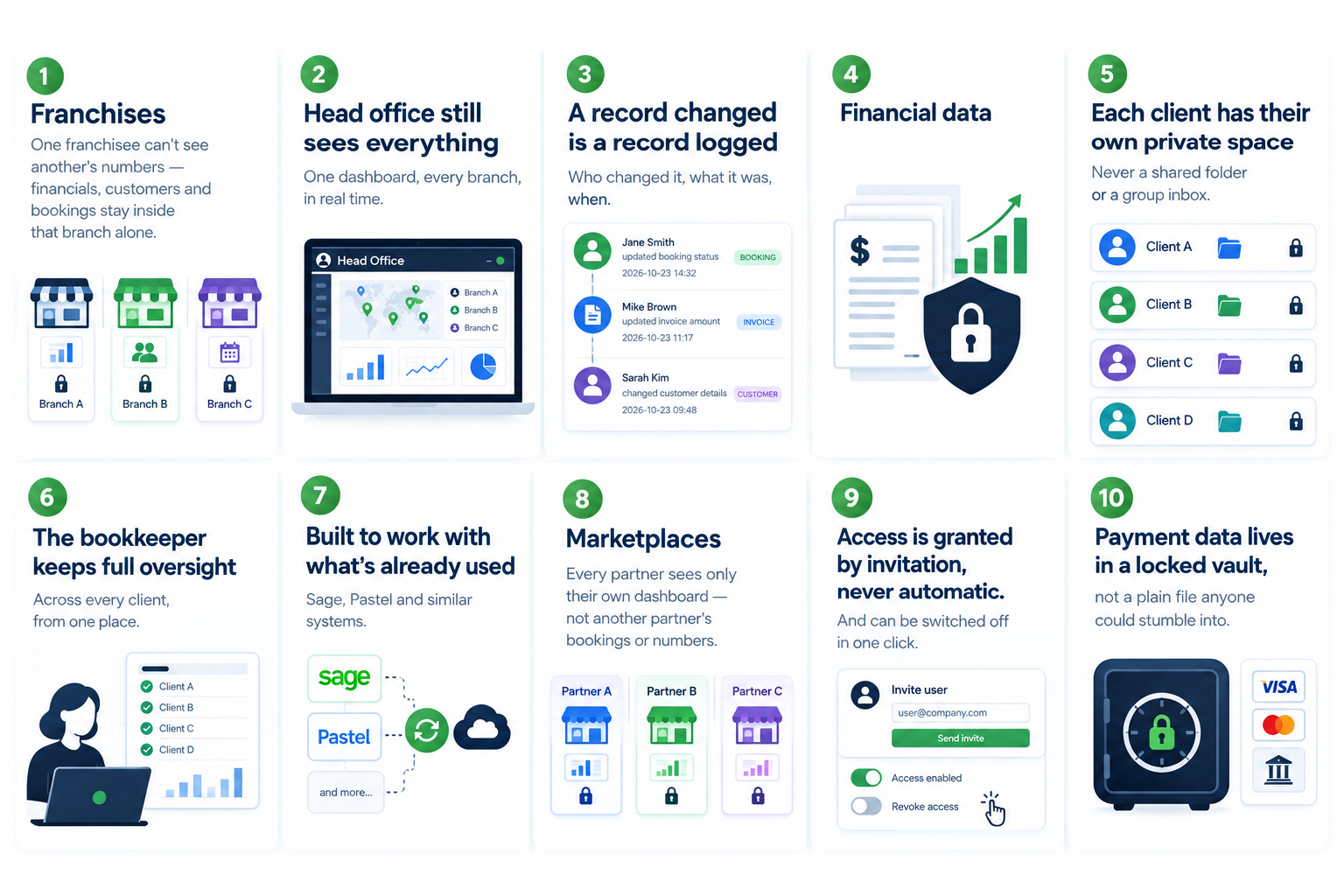
Franchise owners, medical practices, financial and law firms, and anyone whose system has more than one type of user all face the same question sooner or later: who can actually see what, and can you prove it? We build it so the answer is always clear.
The idea is simple, even if the engineering behind it isn't: each person only ever sees what belongs to them — and everything that happens is written down, automatically, so nobody has to take your word for it.
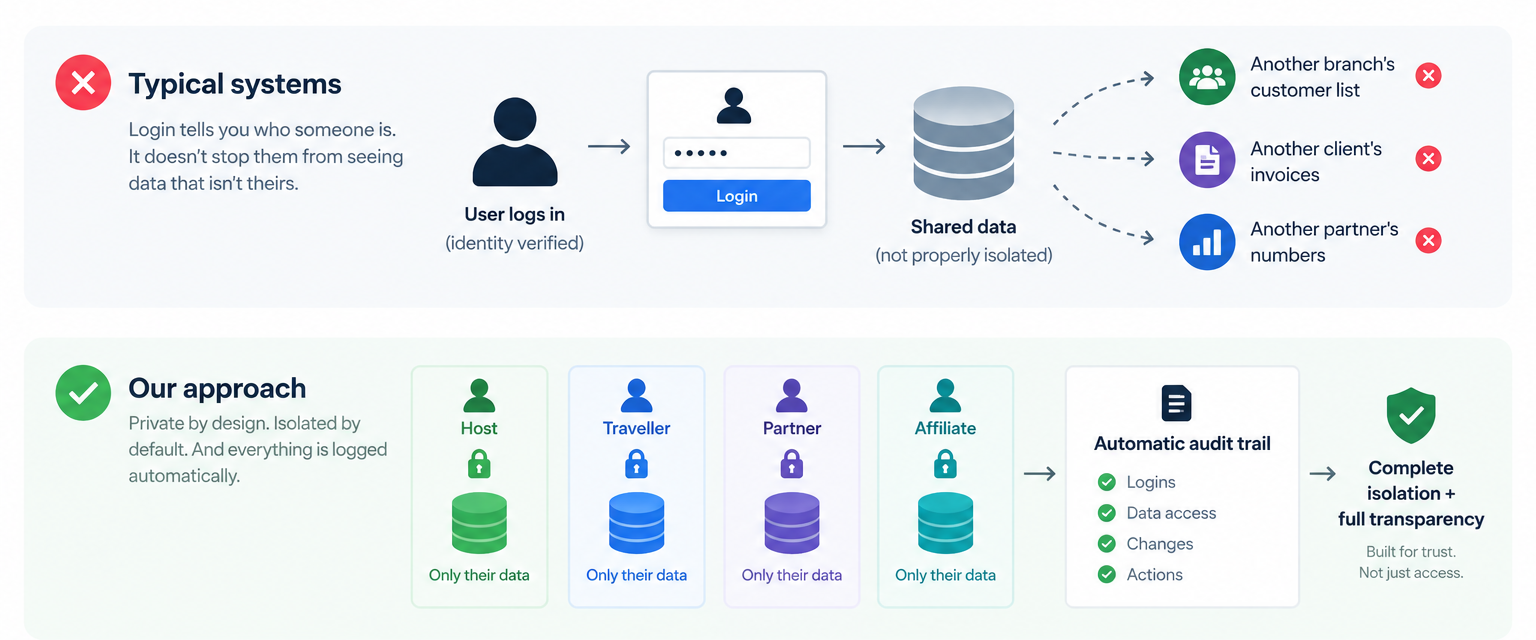
Most systems get this half right with a login screen. A login tells you who someone is. It doesn't stop them from stumbling onto data that was never meant for them — another branch's customer list, another client's invoices, another patient's file, another partner's numbers. That gap is where trust usually breaks down, and it's the part most off-the-shelf software never actually solves.
The exact shape changes depending on who you are. The underlying problem doesn't.
No jargon. Just what changes once this is built properly, from day one.
One dashboard shows exactly who has access to what, right now — not a guess, not a spreadsheet someone forgot to update.
A partner, franchisee or staff member leaves — one click removes their access completely. No waiting on a developer.
Every change is written down automatically — what it was, what it became, when, and who did it.
Access rules, activity records and one-click removal that help you meet your POPIA duties around who can see personal information.
Connects to the tools already in use — Sage, Pastel, Google Workspace — rather than asking a business to start over.
Privacy is part of how the system is built from day one, not a switch someone has to remember to turn on.
This isn't a pitch for something that might work. It's a description of TripSpace Global — a marketplace Forge Vertical built and runs — using the same approach described above.
The exact shape changes depending on the business. The underlying principle doesn't.
Under South Africa's Protection of Personal Information Act, a business holding customer, staff, or client data is the responsible party — legally on the hook for how that information is accessed, stored, and protected. "We trusted the software" isn't a defence if access wasn't actually controlled.
Forge Vertical's founder is also an active bug bounty researcher across HackerOne, Bugcrowd, and YesWeHack — which means the same eye used to find gaps in other people's systems is the one reviewing every access rule before it ships in yours.
No technical homework. This is all that happens.
Each person who logs in sees only their own information, or what they have been specifically given permission to see. A franchisee can't see another franchisee's numbers. A client can't see another client's documents. The rules are built into the system itself, not left to a setting someone could get wrong.
Yes. A normal login only checks who you are. This also controls what you can see once you are in, and writes down everything that happens, so a slip on one screen shouldn't expose someone else's information.
Yes. Any practice that holds sensitive records about patients or clients needs each person to see only what their job requires. We talk through how your practice works and show you what the access should look like. We also confirm with you any rules your professional body sets.
Yes. TripSpace Global, Forge Vertical's own accommodation marketplace, runs on this model today. Partners are individually approved, each sees only their own dashboard, and payment details are kept in a locked, separate vault rather than a plain file.
We talk, in person or on WhatsApp, whichever you prefer. You tell us how your business runs and who needs to see what. We then show you, in plain language, what the access should look like and what it would take to build. You decide once you have seen it.
Tell us how your business runs — branches, practitioners, clients, staff — and we'll show you, in plain language, who should see what.