YouTubers, own your corner.
Store, blog, members and links in one place.
YouTube brings people to you, but it is not yours. Here is how a website adds a store, a blog, a paid membership and neatly stacked affiliate links that you control.
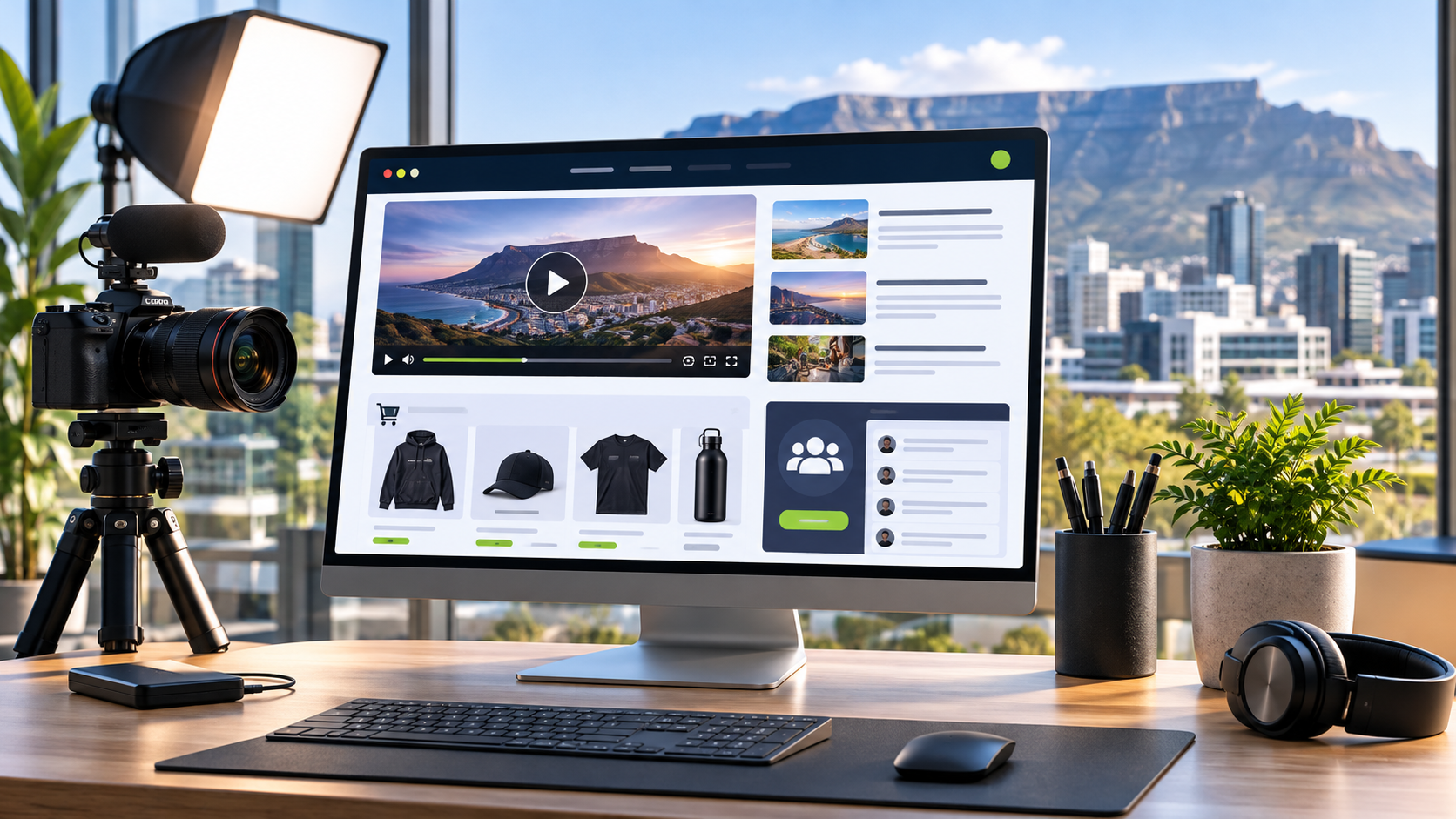
Should a South African YouTuber have their own website? Yes, once you have an audience worth serving. YouTube is where people find you, but it is not yours: the rules, the income and the audience reach can all change without asking you. A website you own gives your followers one place to find everything, and gives you a store, a blog, paid content and affiliate links on your terms.
You are building on rented land
YouTube is a brilliant way to be found. It is also a platform that sets its own rules. Since you do not own the audience relationship, you rely on the platform to keep showing your videos, keep paying you, and keep its conditions the same.
Those conditions do move. To earn from ads you need to join the YouTube Partner Programme, which at the time of writing asks for 1,000 subscribers and 4,000 public watch hours in the last 12 months. A lower tier opens fan funding and shopping at 500 subscribers. Industry reports say that from 1 February 2027 new applicants will need 8,000 watch hours instead of 4,000. That is not something any creator controls.
Ads are also only one slice of what a loyal audience can be worth. A viewer who watches your videos might also buy a hoodie, pay for a members-only series, or use your affiliate link for the camera you recommend. Right now, most of that value has nowhere to go.
// Chapter 02 — Your home baseOne place that is yours, with everything in it
Think of your channel as the shopfront on a busy street and your website as the shop behind it. The street brings people past. The shop is where they can browse, buy, read, sign up and come back.
A creator website can hold:
- Your best content, laid out so a new visitor can see the videos that matter most instead of scrolling through hundreds.
- Your store, with your own merch.
- A blog and article hub, where your ideas live in writing as well as video.
- A paid membership, for the viewers who want extra.
- Your affiliate links, stacked neatly in one place.
- Your contact page and sponsor details, so brands know how to reach you.
It also lines up your presence online. Your name, your logo, your links and your story are the same everywhere, and when someone searches your name, there is a proper page that comes up with your details on it.
// Chapter 03 — The storeYour own merch store: you set the prices and keep control
When you sell through your own store, you decide what to sell, what to charge and how it looks. Your customers' details are yours, so you can tell your buyers about the next drop yourself instead of hoping the algorithm does it.
You do not need a garage full of stock. A print-on-demand supplier prints and sends an item only when someone orders it, and you pay for it then. Or you can hold your own stock if you want to control the quality and the packaging. Either way, the checkout is on your site and the payment comes to you.
Things to think about before you start:
- Payment fees. Every card or EFT payment carries a processing fee. See Chapter 05 for the figures.
- Delivery. Decide how you ship in South Africa and what you charge.
- Returns and customer questions. A store means customer service. Plan for it.
Words keep working after the video has scrolled away
A video is seen in the first days and then mostly forgotten. A well-written article on your site can keep bringing in people from Google for years, because people search in words. Reviews, how-tos, buying guides and explainers all work as articles, and each one can carry your video, your store links and your sign-up form.
An article hub gathers all of it in one place. A visitor who arrives for one piece of content finds ten more, and your site becomes the place people go for what you know.
// Chapter 05 — Paid membershipYour own subscription, for the viewers who want more
You can offer a paid membership from your own site: early access, extra articles, downloads, a private community, behind-the-scenes content. Members pay a monthly amount, and you give them a login to reach what they paid for.
You can already do something similar on other platforms, so here is how they compare, from the figures we could find:
| Option | What it costs you | Worth knowing |
|---|---|---|
| YouTube memberships | YouTube keeps a share of each membership. The help page does not state the percentage. | Offered in about 90 locations. Check that South Africa is on YouTube's list for your channel. |
| Patreon | 10% platform fee for creators who joined from 4 August 2025, plus payment processing, currency conversion and payout fees. | Older accounts may be on 5%, 8% or 12%. |
| Your own site with a South African payment provider | Payment fees only. PayFast lists 3.2% plus R2.00 for cards and 2% (minimum R2.00) for instant EFT, with no monthly fee. All excluding VAT. | You carry the cost of building and hosting the site, and you handle member support yourself. |
A worked example. Say 200 members each pay R99 a month by card. At PayFast's card rate, the fee is about R5.17 a payment, or around R1,034 a month for all 200 (excluding VAT, and assuming the same card rate applies to recurring payments, which PayFast's fee page does not state separately). Ten percent of the same R19,800 would be R1,980 before any processing fees. That is the "side fee" to run your own operation: you pay a payment provider a small cut instead of a platform a larger one.
Be honest with yourself about the other side. On your own site you also pay for the site and its hosting, and you are the one who answers when a member cannot log in. For a small membership, a platform like Patreon may be less work. The own-site route pays off as your membership grows, or when you want your members, your branding and your data in one place.
One practical point: hosting lots of private video yourself costs money for every viewer. Many creators keep video on YouTube as unlisted or members-only and put the extras, such as articles, downloads, early notes and community, behind the login on their own site.
// Chapter 06 — Affiliate linksPut your affiliate links where followers can actually find them
If you recommend gear, software or services, your links are probably scattered across video descriptions that most viewers never read. On your site you can build a tidy "what I use" page, sorted into categories, with a short line on why you picked each one. Followers pick and choose, and you can update a link in one place instead of in two hundred descriptions.
One rule: tell your audience when a link is an affiliate link. It is the honest thing to do, it is what YouTube expects, and it keeps the trust that makes your recommendations worth following.
// Chapter 07 — The honest partWhat a website will not do
- It will not find you an audience. YouTube does that. Your site works because your channel sends people to it, so keep putting the link in every description and pinned comment.
- It is more work than posting a video. A store needs orders packed, a membership needs support, and a blog needs writing.
- It is not necessary on day one. If you are still working towards your first thousand subscribers, a simple page with your links and contact details is enough.
- It will not replace YouTube income overnight. It adds streams. Each one grows at its own pace.
Start with the piece that fits your audience best today, and add the next piece when the first one is running well.
// Chapter 08 — What it costs and what we doStart small, add as you grow
Our simple website starts at R3,500 once-off, including a .co.za domain and a year of hosting, and a bigger site starts at R4,500. A store, a membership or a login area is a bigger build, and we quote it in writing before you pay anything. Work starts after a 50% deposit. Our Website Retainer, at R650 a month, handles regular changes and monitoring so you do not have to touch code. Everything is on our pricing page.
What you get from us is a site you own, built to load quickly on a phone (which is how most of your audience will visit), with the search side set up properly, so that when someone looks for you, you come up.
Tell us about your channel and what you would like your audience to find in one place. We will tell you honestly what is worth building first.
Send your channel link and a few lines about what you sell or want to sell. You get a fixed quote in writing, and you can start small: a home page and links today, a store or membership when you are ready.
Email [email protected] →Do I need a website if I already have a YouTube channel?
You do not need one on day one, but it becomes valuable as your audience grows. A website you own gives followers one place for your best content, store, blog, membership and affiliate links, and it does not depend on a platform's rules or algorithm.
What do I need to earn from ads on YouTube?
At the time of writing, the YouTube Partner Programme asks for 1,000 subscribers and 4,000 public watch hours in 12 months, or 10 million Shorts views in 90 days. A lower tier for fan funding and shopping asks for 500 subscribers. Industry reports say the full tier moves to 8,000 watch hours for new applicants from 1 February 2027. Check YouTube's own page before you apply.
How much does it cost to run a paid membership on my own site?
Mainly the payment provider's fee. PayFast lists 3.2% plus R2.00 per card payment and 2% (minimum R2.00) for instant EFT, with no monthly fee, all excluding VAT. On top of that you pay for the website and hosting. Confirm recurring-payment terms with the provider before you plan.
Can I sell merch without holding stock?
Yes. Print-on-demand suppliers print and ship an item only when it is ordered, so you pay for it at that point. You can also hold your own stock if you want control over quality and packaging.
Do I have to disclose affiliate links?
You should always tell your audience when a link is an affiliate link. It is honest, it is what YouTube expects, and it protects the trust your recommendations depend on.